


Books
Dr. Hays's books are available from Amazon.com and APAOnline.
Books
Creating Well-Being: Four Steps to a Happier, Healthier Life
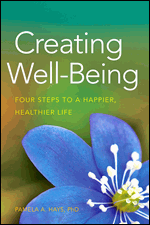
(2014). Washington, D.C.: American Psychological Association.
Texts. Emails. Errands. Endless to-do lists. Even if we’re keeping up, are we truly enjoying our lives? Remedies like a day at the beach may bring short-term relief, but what brings the lasting changes that help us be our best selves? Pamela Hays has written this book to help you take control and fulfill your dreams. Full of fun exercises and real-life examples, the book shares a tried and true approach that is easy to understand, learn, and accomplish. Get started by taking stock of your personal strengths. Learn to realistically assess problems and connect each to a solution. Become aware of the thought traps that hold you back. Take action on the problems that can be changed, and manage your emotions when problems are beyond your control. Based on the author’s 20+ years of experience and sound psychological principles and research, this book will help you cultivate a lasting talent for self-care and well-being.
.jpg) Connecting across Cultures:
Connecting across Cultures:
The Helper’s Toolkit. Thousand Oaks, CA: SAGE.
136pp. ISBN: 9781452217918.
Chock-full of fun exercises, surprising tips, and real-world case examples, Connecting across Cultures: The Helper’s Toolkit provides both students and professionals in social services, health care and education with the skills to develop respectful, smooth relationships with their clients and with the community at large. The book offers communication tools to defuse defensive interactions, resolve conflicts constructively, and engage respectfully. Written in a warm, inviting style, the author shares her own mistakes as she explains what not to do and how to do it better. The book provides practical, hands-on strategies for connecting with people across differences related to ethnicity, race religion, nationality, sexual orientation, disability, age, gender, and class. Because cross-cultural relationships add a level of difficulty to all the usual relationship challenges, this book will help you with every relationship you may encounter.
Interesting, Accessible, and Excellent Content "This book is a short, but very helpful guide to making connections with diverse clients. It's written by Pamela Hays who is also the author of other excellent multicultural assessment and treatment materials. What I like best is not only the fact that it will help counselors and psychotherapists develop their cultural self-awareness, cultural knowledge, and culturally-oriented therapy skills, but that it's also written in a manner that's very clear and consequently, very accessible. It has many different reflective learning activities and concrete examples focusing on language and behavior that will help contribute the the reader's cultural sensitivity. Excellent addition to the field!" - John Sommers-Flanagan
"I have been a fan of Pamela Hays' work for many years (her ADDRESSING model is a huge contribution to the field of multicultural counseling), and this book follows her other work in being thoughtful, well-organized, and relevant. The vignettes in this book are especially helpful due to their complexity. Instead of creating a situation in which "right" and "wrong" moves are easily seen, these vignettes deal with situations that are more nuanced and call for careful thought before proceeding -- I think this may be especially helpful for many who know the basics of how to interact with dissimilar others in a surface way but might inadvertently make mistakes (sometimes with large consequences) with regard to interacting with them on a deeper level. Would highly recommend this book." - Jennifer Teramoto Pedrotti
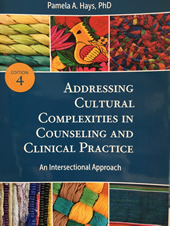 Addressing Cultural Complexities in Counseling and Clinical Practice: An Intersectional Approach (4th edition, 2022).
In an increasingly diverse society, mental health providers must be able to work effectively with a wide variety of clients. Hays’s best-selling text invites readers to move beyond a one-dimensional view of identity to a nuanced understanding of the overlapping cultural influences that affect us all. Her ADDRESSING framework encompasses Age and generational influences, Developmental or other Disability, Religion and spirituality, Ethnic and racial identity, Indigenous heritage, National origin, Socioeconomic/class status, Sexual orientation, and Gender.
This fourth edition remains richly illustrated with case examples, and features two new chapters: one on culturally adapted cognitive behavioral tools and techniques and another on trauma due to racism and other systemic forms of oppression. Additional new material includes an updated discussion of gender identity with attention to clinically relevant research regarding transgender and nonbinary people, more on people with disabilities (the largest minority group in the U.S.), the latest terminology and language regarding diverse minority groups, and a special section on social justice and its relationship to therapeutic practice. Each chapter includes a Key Ideas summary and practice exercises, making it ideal for personal education or group use."Yet again, Dr. Pamela Hays has delivered excellence. This new edition gives mental health providers a comprehensive, user-friendly guide for providing inclusive clinical assessment and interventions to people who identify with diverse identities. Their voices and cultural contexts are highlighted through clinical examples in this book in addition to the most recent psychological research – making this an ideal resource for students, trainees, and early career professionals." – Linda R. Mona, PhD, Licensed Clinical Psychologist, Long Beach, CA.
"Dr. Hays artfully weaves together critical insights that go beyond stereotyping to improve practitioner understanding of the complexity of diversity and intersectionality, how to make meaningful connections and strengthen the working alliance, and how to increase cultural responsiveness in both treatment and assessment." –Wei-Chin Hwang, PhD, Prof. of Psychological Science, Claremont McKenna College
"... may be the best book yet published for clinicians seeking a practical guide for working with patients across cultural boundaries." - Anthony Marsella, PhD, Professor Emeritus of the University of Hawaii
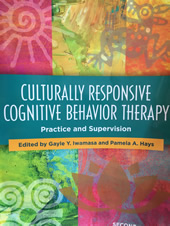
Culturally Responsive Cognitive Behavior Therapy: Practice and Supervision (2nd edition, 2019; edited with Gayle Y. Iwamasa)
Culturally Responsive Cognitive Behavior Therapy: Practice and Supervision is the first book to integrate cultural influences into cognitive-behavioral therapy (CBT). This engagingly written second edition describes the application of CBT with people of diverse cultures and discusses how therapists can refine CBT to increase its effectiveness with clients of many cultures. The contributing authors examine the characteristics of some of the most common cultural groups in the United States including American Indian, Latinx, Asian, South Asian, and African American, as well as groups less commonly considered in multicultural psychology books: people of Alaska Native, Arab, and Orthodox Jewish heritage.
The volume also describes the use of CBT with older adults, people with disabilities, and gay and lesbian individuals, including examples of people who hold bicultural and multicultural identities. Numerous case examples provide practical information grounded in an empirically supported theory, making this book a practical resource for every therapist.
"Now when therapists ask me in my workshops, 'what should we know about delivery of cognitive-behavioral therapy to people of different cultures?' my answer will enthusiastically include a recommendation of this comprehensive guide" --Christine A. Padesky, PhD, author of Mind Over Mood.
"If you’re not already skilled at adapting CBT to your clients’ cultures, you need this book! An understanding of culture, which may strongly affect clients’ perceptions and behavioral patterns, is essential to accurately conceptualizing the individual and delivering effective treatment." – Judith S. Beck, PhD, President, Beck Institute for Cognitive Behavior Therapy, & Clinical Professor, University Of Pennsylvania
"This excellent new edition illustrates effective and creative CBT cultural adaptations. Using an integrative cultural and clinical perspective, contributors offer best practices for working with diverse clients within a CBT cultural competence approach. I strongly recommend this invaluable book to all psychotherapists, trainees, supervisors, and educators." – Lillian Comas-Díaz, PhD, author of Multicultural Care: A Clinician’s Guide to Cultural Competence
"How can I make cognitive behavior therapy culturally relevant? Iwamasa and Hays answer this question with the latest conceptual, research, and clinical applications from leaders in the field who consider culture in terms of age, race/ethnicity, sexuality, disability, and religion." – Gordon C. Nagayama Hall, PhD, University of Oregon
DVD's (available only to psychotherapy professionals):
For info, go to: www.apa.org/pubs/videos/4310900.aspx
Additional articles:
Hays, P.A. (2021). Finding a place in the multicultural revolution. In M. E. Gallardo (Ed.), Developing cultural humility: Embracing race, privilege and power. Cognella.
Hays, P.A. (2014). An international perspective on the adaptation of CBT across cultures. Australian Psychologist, 49, 17-18.
Hays, P. A. (2009). Integrating evidence-based practice, CBT, and multicultural therapy:10 steps to culturally competent practice. Professional Psychology: Research and Practice, 40, 354-360.
Hays, P. A. (2007). A strengths-oriented approach to psychotherapy with Middle Eastern people. In C. Muran (Ed.), Dialogues on Difference: Studies of diversity in the therapeutic relationship (pp. 243-250). Washington, D.C.: American Psychological Association.
Hays, P. A. (2019). CBT with Alaska Native people. In G. Y. Iwamasa & P. A. Hays (Eds.), Culturally Responsive Cognitive Behavioral Therapy: Practice and Supervision. American Psychological Association.
Hays, P.A. (1996). Addressing the complexities of culture and gender in counseling. Journal of Counseling and Development, 74, 332-338.
Hays, P.A. (1996). Cultural considerations in couples therapy. Women and Therapy, 19, 13-23.
Hays, P.A. (1996). Culturally responsive assessment with diverse older clients. Professional Psychology: Research & Practice, 27, 188-193.
Hays, P.A. (1995). Multicultural applications of cognitive behavior therapy. Professional Psychology: Research & Practice, 26, 309-315.
Hays, P.A., & Zouari, J. (1995). Social change, stress, and mental health among rural, village and urban Tunisian women. International Journal of Psychology, 30, 69-90.
Hays, P.A. (1991). Mental health, social support, and life satisfaction among Vietnamese, Lao, and Cambodian refugees. In N. Bleichrodt & P.J.D. Drenth (Eds.), Contemporary Issues in Cross-Cultural Psychology (pp. 275-284). Amsterdam: Swets & Zeitlinger.
Santora, J., & Hays, P.A. (1998). Coping outside traditional roles: The case of noncustodial mothers and implications for therapy. Women & Therapy, 21, 53-66.